

Poor garden drainage is one of the most common reasons UK gardens struggle, particularly from autumn through spring. Beds stay wet for days after rain, lawns become muddy, and plants either rot or fail to thrive. While heavy rainfall often gets the blame, the real issue is usually the soil’s ability to move water and air through the root zone.
When garden soil drains properly, it absorbs rain steadily, stores moisture for plant roots, and allows excess water to move downward after heavy weather. When drainage is poor, water sits in the soil, oxygen is pushed out, and roots begin to suffer.

This guide focuses on why garden soil doesn’t drain properly in typical UK conditions and how to fix poor drainage naturally. For a complete overview of drainage causes across all soil types, see Garden Drainage Problems in the UK: Causes, Fixes & Long-Term Solutions. The aim is not to dry your garden out completely, but to restore healthy balance so soil holds moisture while allowing excess water to drain away.
Quick Answers
Why is my garden not draining properly?
Most UK gardens suffer poor drainage due to compacted soil, heavy clay, low organic matter, or surface sealing that stops water soaking in and moving downward.
What is the best way to fix poor garden drainage naturally?
Improving soil structure with organic matter, reducing compaction, and protecting the soil surface usually delivers the biggest long-term improvement.
Do I need a drainage system to solve drainage problems?
Often no. Many drainage issues improve dramatically once soil structure is restored. Systems are only needed when water volume overwhelms natural absorption.
How long does it take to improve garden drainage?
Small improvements can appear quickly, but lasting drainage change usually develops over one to three seasons of consistent soil care.
Why poor garden drainage is so common in the UK
The UK’s climate plays a major role in drainage problems. Frequent rainfall, mild winters, and long damp periods mean soil rarely gets the chance to dry fully and recover naturally. When soil structure is weak or compacted, water quickly builds up in the root zone.
In many parts of the world, soil experiences long dry seasons that help restore structure naturally. In much of the UK, soils remain damp for months at a time, allowing small problems to turn into persistent drainage issues.
The most common contributors to poor garden drainage include:
- compacted soil from everyday use
- heavy clay holding water tightly
- low organic matter levels
- surface sealing after heavy rain
- natural dips where water collects
Most gardens suffer from more than one of these at the same time.
What poor drainage actually does to your soil
Drainage problems are not just about water sitting on the surface. The real damage happens underground.
Healthy soil contains air spaces between soil particles. These spaces hold oxygen that roots need to function properly. When soil becomes saturated, those air spaces fill with water and oxygen levels drop sharply.
As oxygen disappears:
- roots weaken and rot more easily
- nutrient uptake slows
- plant growth becomes stressed
- disease pressure increases
This is why gardens with poor drainage often show yellowing leaves, slow growth, and repeated plant losses even when feeding is applied.
Common signs your garden soil isn’t draining properly
Some drainage problems are obvious, while others are easy to miss.
Surface signs
- puddles forming after moderate rain
- soil staying dark and wet for days
- muddy lawns and footpaths
- algae or slime on compacted areas
- moss spreading in lawns
Soil signs
- sour or stagnant smell when digging
- soil smearing rather than crumbling when wet
- grey or bluish subsoil layers
- a dense compacted layer below the surface
Plant signs
- plants rotting at the base
- slow spring growth
- yellowing leaves
- patchy lawns that never thicken
- vegetables sitting still in cool wet soil
A simple drainage test you can do at home
You don’t need specialist equipment to understand how well your garden drains.
Dig a hole about 30cm deep and roughly the width of a spade. Fill it with water once and let it drain away fully. Then fill it again and time how long it takes to drain.
As a general guide:
- Under 4 hours – drainage is reasonable
- 4 to 8 hours – restricted drainage
- 8 to 24 hours – poor drainage
- Over 24 hours – very poor drainage
Test a few areas, as drainage often varies across a garden.
Why quick drainage fixes rarely last
Many gardeners try gravel trenches, deep digging, or repeated feeding to cope with wet soil. These may offer short-term relief but usually fail to address the underlying cause.
If soil structure remains weak or compacted, water will continue to sit in the root zone and drainage problems will return each wet season.
Long-term improvement nearly always comes from improving how the soil itself handles water.
What causes poor garden drainage in the first place?
Most drainage problems in UK gardens come down to one thing: the soil cannot absorb water quickly enough, and it cannot hold enough air at the same time.
That usually happens for a small set of reasons. Once you identify which ones apply to your garden, the right fix becomes much clearer.
1) Compacted soil (the most common cause)
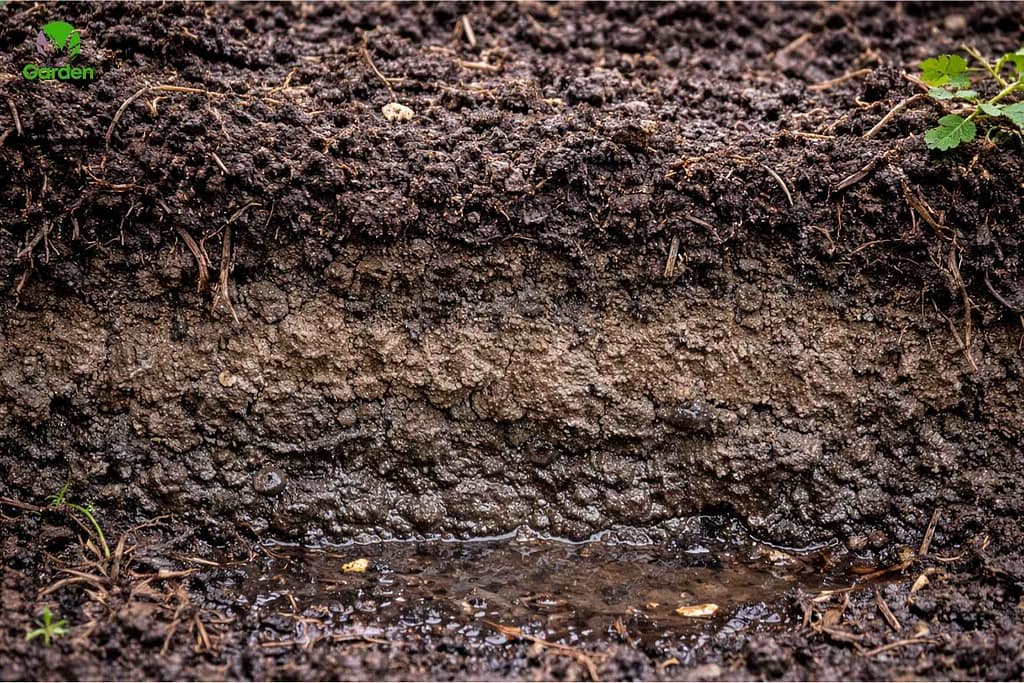
Compaction is when soil particles are pressed tightly together, squeezing out the pore spaces where air and water should move. In compacted soil, rainfall can’t soak in properly and water either pools on the surface or sits in the root zone.
Compaction happens surprisingly easily in UK gardens because soil is often damp for long periods. Walking on wet soil, mowing a soft lawn, wheelbarrows, repeated routes, pets, and even regular planting in the same beds can gradually create dense layers just below the surface.
Typical signs of compaction include:
- a fork that stops suddenly a few inches down
- soil lifting in smeared slabs rather than crumbs
- water pooling even after moderate rain
- plants with shallow roots and weak growth
In many gardens, the worst compaction sits around 5–15cm down. Water moves down until it hits that dense layer, then spreads sideways and lingers.
2) Heavy clay soil holding water tightly
Clay soil drains slowly because clay particles are extremely small and naturally pack together tightly. If your soil is clay-heavy, see how to improve drainage in clay soil in UK gardens for the most effective long-term approach. That means there’s less space for water to move through compared to sandy or silty soils.
Clay itself isn’t “bad” soil. It can be nutrient-rich and brilliant for long-term plant health once structure improves. The real problem is when clay becomes poorly structured and collapses into dense plates, especially after being worked when wet or left bare through winter.

Clay drainage problems usually look like:
- sticky, heavy soil in winter
- hard, baked soil in summer
- puddling and slow spring warm-up
Clay gardens usually improve best with organic matter and gentle management rather than digging or adding grit.
3) Low organic matter (soil has nothing to “hold structure”)
Organic matter is the engine that keeps soil open and crumbly. It feeds soil life, helps particles bind into stable aggregates, and creates a structure that can absorb rainfall without collapsing.
When organic matter is low, soil structure becomes weak. Fine particles settle and pack tightly. After rain, the surface can seal over, and drainage becomes worse each season.
Organic matter levels are often low in:
- new build gardens with imported topsoil
- gardens where clippings and leaves are always removed
- beds that are dug frequently but rarely mulched
- lawns that are fed but never top-dressed
The good news is that organic matter is one of the easiest things to add, and it delivers the most reliable long-term improvement for drainage.
4) Surface sealing after heavy rain
Surface sealing happens when heavy rain breaks down soil crumbs into fine particles that pack into a tight layer on the surface. Once sealed, water cannot soak in properly. It pools, runs off, or finds the lowest point.
Surface sealing is common when:
- soil is left bare through autumn and winter
- soil is finely raked or over-tilled
- there is little organic matter holding crumbs together
Even a thin mulch layer can dramatically reduce sealing and help rain soak in more evenly.
5) A low spot or water flowing into the same area
Some drainage issues are not just about the soil. They’re about where water is collecting. If parts of the garden stay saturated for days, follow our practical steps for fixing a waterlogged garden in the UK.
A garden can become waterlogged simply because:
- it sits at the bottom of a slope
- hard surfaces direct runoff into beds
- ground levels dip in one corner
- paths trap water against borders
In these situations, even improved soil can struggle because too much water is arriving in one place too often. A small amount of reshaping or redirecting runoff can make a big difference.
The soil-first approach: what actually fixes poor garden drainage
Before thinking about drains or replacing soil, it’s worth knowing this:
Most poor drainage in UK gardens improves dramatically when soil structure is rebuilt and compaction is reduced.
That’s because the soil becomes better at:
- absorbing rainfall quickly (better infiltration)
- holding air in the root zone (better oxygen levels)
- moving surplus water downward after heavy weather
So the most reliable drainage fixes usually fall into three foundations:
- build organic matter so soil forms stable crumbs
- reduce compaction so pore spaces stay open
- protect the surface so rain doesn’t seal it again
How to reduce compaction without wrecking your soil
The common mistake with wet, poorly draining soil is trying to “dig it better”. In UK conditions, digging when soil is damp often smears soil particles together and creates even denser structure once it settles.
A gentler approach works far better.
For borders and beds: lift and crack, don’t turn
Use a garden fork (or broad fork if you have one) to loosen soil without destroying natural layering.
Method:
- push the tines deep into the soil
- rock back gently to lift and crack the ground
- move along in a grid pattern
- avoid turning soil over
This creates channels for water and roots, while keeping the soil profile more stable.
Timing matters. Only do this when soil is moist but not wet. If it smears and shines, it’s too wet and you’ll do more harm than good.
For lawns: aeration is the best starting point
Lawns compact quickly because they take constant foot traffic and mowing. If your lawn becomes muddy and waterlogged, aeration is usually the first practical step — and our full guide to poor lawn drainage in the UK shows exactly what to do season by season.

Better options include:
- hollow-tine aeration (removes plugs and creates real space)
- spiking (helps a little but closes up faster)
After aeration, brushing compost or a fine top-dressing into the holes helps improve structure over time.
Organic matter: the most effective long-term drainage improvement
If you only do one thing to improve poor garden drainage, make it this: add organic matter consistently.
Organic matter helps soil particles bind into stable crumbs (aggregates). Those crumbs create pore spaces where air and water can move. It also feeds worms and soil organisms, which naturally create channels and keep the soil open.
Best organic materials for UK gardens
- well-rotted garden compost
- leaf mould
- composted manure
- green waste compost
Apply as a surface mulch rather than digging it in. A layer of around 5–8cm once or twice a year is a strong starting point.

Autumn is ideal because it protects soil through winter rain, reduces sealing, and gives soil life time to incorporate the material naturally.
How quickly organic matter improves drainage
Some benefits can appear within weeks, particularly improved infiltration at the surface. However, real structure change takes longer.
In most UK gardens:
- noticeable improvement often appears within one year
- strong, resilient structure usually develops over two to three seasons
This is slower than “quick fixes”, but the results last and continue improving each year you keep up the habit.
Preventing surface sealing so water can soak in properly
Even when soil structure is improving below ground, poor drainage can persist if the surface keeps sealing after heavy rain.
Surface sealing happens when raindrops break soil crumbs into very fine particles that pack tightly together at the top layer. Once sealed, water struggles to soak in and instead pools, runs off, or flows into the lowest part of the garden.
This is one of the main reasons some gardens puddle badly even though the soil beneath is slowly improving.
Simple ways to stop soil sealing
- keep beds mulched year round
- avoid leaving soil bare through autumn and winter
- plant densely where possible
- use cover crops in vegetable beds
- avoid over-raking or fine tilling
Even a thin layer of organic material dramatically improves infiltration and protects soil structure.
Managing water movement around the garden
Once soil can absorb water better, many drainage problems ease naturally. But in some gardens, too much water arrives in one place too often.
In these situations, improving soil structure works best when combined with simple water flow management.
Using gentle reshaping to prevent pooling
Small changes to garden levels can make a big difference.
- raise low spots slightly with soil and compost
- create gentle slopes away from buildings
- reshape beds so water doesn’t sit in hollows
- check that paths aren’t trapping water against borders
These changes don’t need heavy landscaping. Often just a few centimetres of adjustment prevents persistent puddles.
Redirecting runoff from hard surfaces
Water from roofs, patios, driveways, and paths can overwhelm garden soil during heavy rain.

Ways to reduce this pressure include:
- directing downpipes into water butts or soakaway areas
- creating shallow gravel channels to guide water away
- breaking up large paved areas with planting strips
- ensuring slopes move water away from sensitive beds
Even modest runoff control can dramatically reduce waterlogging near buildings.
When drainage systems are actually worth considering
In most UK gardens, soil improvement alone solves the majority of drainage problems. However, there are situations where engineered drainage becomes helpful.
You may need additional drainage when:
- your garden sits in a natural hollow
- groundwater levels are high
- large volumes of runoff enter one area
- water stands for days despite consistent soil improvement
Common options include French drains, soakaways, or surface channels.
Even when installing drainage systems, continuing soil structure work is essential. Systems move water away, but healthy soil keeps roots functioning properly.
How to know if your drainage fixes are working
Drainage improvement happens gradually, but there are clear signs of progress.
- water soaking in faster after rain
- fewer puddles forming
- soil becoming crumbly rather than sticky
- plants growing stronger and faster
- lawns thickening and staying firmer
Repeating the simple drainage hole test once or twice a year gives a reliable measure of improvement.
Why poor drainage keeps returning when soil is neglected
Soil structure can be lost surprisingly quickly if it is compacted again, left bare, or worked when wet.
Common setbacks include:
- walking on wet beds
- heavy digging during damp periods
- removing all organic debris every season
- allowing soil to sit bare through winter
Consistent gentle care keeps drainage functioning naturally.
How improved drainage changes the whole garden
Once soil drains properly, roots grow deeper, plants become more resilient, and nutrient uptake improves naturally.
Gardeners usually notice:
- stronger spring growth
- fewer diseases
- better flowering and yields
- less moss in lawns
- soil that’s easier to work year round
Fixing poor garden drainage is one of the most powerful improvements you can make to long-term garden health.
Frequently Asked Questions About Poor Garden Drainage
What causes poor garden drainage in the UK?
Poor garden drainage is usually caused by compacted soil, heavy clay, low organic matter, surface sealing after rain, or water collecting in low areas of the garden.
Can poor drainage improve without installing drains?
Yes. Many drainage problems improve naturally when soil structure is rebuilt with organic matter and compaction is reduced.
How do I know if my garden drains badly below the surface?
Dig a hole around 30cm deep and fill it with water. If it takes longer than 8 hours to drain, soil drainage is restricted.
Does mulching really help poor garden drainage?
Yes. Organic mulch improves soil structure, prevents surface sealing, and helps water soak in more evenly over time.
Is poor drainage worse in winter?
Yes. Frequent rain, low evaporation, and cold saturated soil in winter make drainage problems far more severe in UK gardens.
Should I dig heavy soil to improve drainage?
Usually not. Digging wet soil often worsens compaction. Gentle loosening and organic matter work far better long term.
A sensible place to start
If your garden doesn’t drain properly, begin with soil structure. Add organic matter regularly, reduce compaction, and protect the soil surface.
Most UK gardens respond extremely well to these simple natural methods. If you’d like the full drainage overview covering clay, compaction, and waterlogging together, return to the main guide here: Garden Drainage Problems in the UK: Causes, Fixes & Long-Term Solutions. Over time, drainage improves permanently and plant health follows.