

In many UK gardens, vegetable plants look reasonable above ground but struggle to develop strong root systems below the surface.
Growth remains slow, plants wilt quickly in warm weather, feeding produces little improvement, and harvests are often disappointing.
One of the most common hidden causes is shallow root development.
In heavy UK soils, especially clay-based and compacted ground, roots frequently fail to grow deeply and spread properly.
Instead of forming strong underground networks, they remain close to the surface where conditions are unstable.
This limits water access, restricts nutrient uptake and leaves plants vulnerable to stress throughout the growing season.
Understanding why roots stay small — and how to fix the soil conditions responsible — is one of the most effective ways to improve vegetable performance in UK gardens.
Why Roots Stay Small in Heavy UK Soil – Quick Answer
- Heavy clay soil becomes dense and hard for roots to penetrate
- Compacted layers block deep root growth
- Waterlogged soil removes oxygen from the root zone
- Cold, wet conditions slow root development
- Shallow roots dry out quickly and absorb fewer nutrients
In many UK gardens, small root systems are caused by compacted, poorly drained soil rather than lack of feeding. Improving soil structure with organic matter, reducing compaction and managing drainage allows roots to grow deeper and stronger naturally.
Why Root Depth Matters for Healthy Vegetable Growth
Roots are responsible for almost everything a plant needs to survive.
They anchor the plant, absorb water, take in nutrients and interact with beneficial soil organisms.
In healthy soil, vegetable roots naturally grow downward and outward in search of stable moisture and nutrients.
Deeper root systems allow plants to:
- Access water during dry spells
- Absorb nutrients more efficiently
- Remain stable in wind and heavy rain
- Grow faster and stronger
When roots remain shallow, plants are forced to rely on surface moisture and limited nutrient zones.
This makes growth inconsistent and highly sensitive to weather changes.
Why Heavy UK Soil Restricts Root Growth
Across much of the UK, garden soil contains high levels of clay or compacted subsoil.
These soils behave very differently from loose, well-structured growing ground.
Clay particles are extremely fine and pack tightly together when wet.
Over time, rainfall, foot traffic, digging and natural settling compress soil further.
The result is dense layers that roots struggle to penetrate.
Instead of moving downward, roots hit resistance and spread sideways near the surface.
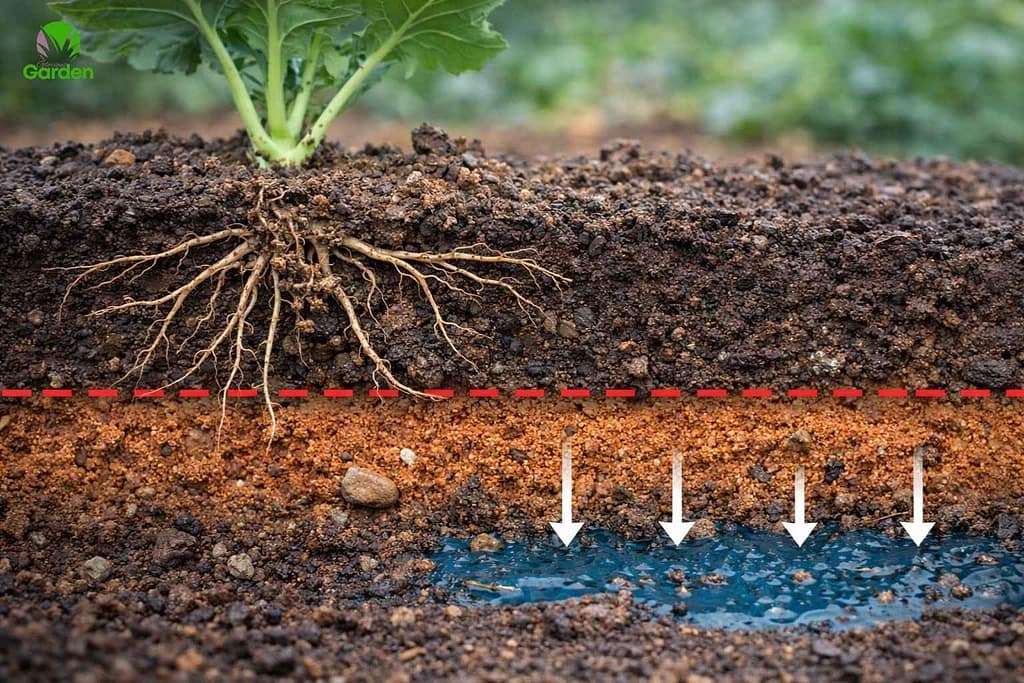
This problem is closely linked to soil compaction in UK gardens, which affects a large number of vegetable beds without gardeners realising.
How Compacted Soil Physically Blocks Roots
Compacted soil contains very few air spaces between particles.
Without these spaces:
- Roots cannot push through easily
- Oxygen movement is restricted
- Water drains poorly
When roots encounter compacted layers, growth slows dramatically.
Fine root hairs that absorb water and nutrients become damaged.
The plant responds by spreading roots sideways in the softer surface layer.
This shallow rooting pattern becomes permanent unless soil structure improves.
Why Poor Drainage Makes Root Problems Worse
Drainage and compaction usually occur together.
When soil holds too much water, air spaces fill with moisture and oxygen disappears.
Roots need oxygen to grow and function properly.
In waterlogged soil:
- Root growth slows
- Root tips may rot
- Nutrient uptake drops
Even if soil looks dry on the surface, saturated layers often exist underneath.
This keeps roots trapped in unstable conditions near the top.
Improving water movement through soil is therefore essential for deeper root development.
This process is explained fully in How to Improve Garden Drainage in UK Soil.
Why Shallow Roots Cause Slow Growth and Poor Harvests
When roots remain close to the surface, plants become highly dependent on frequent watering.
Surface soil dries quickly in warm or windy weather.
Each drying cycle stresses the plant.
This leads to:
- Wilting in hot conditions
- Slow leaf development
- Reduced flowering and cropping
- Greater susceptibility to disease
Nutrients applied to the surface may also wash away easily instead of being absorbed.
Over time, plants remain permanently under stress even when cared for properly.
Why Feeding Does Not Fix Shallow Root Problems
Many gardeners respond to slow growth by adding fertiliser.
While this may briefly boost leaf colour, it rarely solves the underlying issue.
Shallow, oxygen-starved roots cannot absorb nutrients efficiently.
In compacted or waterlogged soil, nutrient uptake remains restricted no matter how much feed is added.
This cycle is explored in more detail in Why Feeding Plants Often Doesn’t Fix Slow Growth in UK Soil.
Until soil structure improves, feeding alone produces limited results.
How Cold Soil Contributes to Shallow Root Systems
Heavy UK soils warm slowly in spring.
Cold soil further restricts root activity and growth.
Roots remain sluggish, particularly in wet compacted conditions.
This keeps development concentrated near the surface where temperatures fluctuate rapidly.
The relationship between temperature and root function is covered in Cold Soil Problems in UK Gardens.
Improving drainage and structure allows soil to warm faster and supports deeper root development.
Signs Your Vegetables Have Shallow Roots
Common indicators include:
- Plants wilting quickly in warm weather
- Roots spreading sideways when plants are pulled up
- Very few deep roots visible
- Slow growth despite watering and feeding
- Water pooling after rain
If several of these are present, soil structure is almost always limiting root growth.
The next section explains how to fix the underlying causes and rebuild soil for healthier root systems.
How to Fix Shallow Roots in Heavy UK Soil
Improving root depth is not about forcing roots downward.
It is about changing the soil environment so roots can grow naturally.
The focus should always be on drainage, structure and oxygen movement.
Improve Drainage to Restore Oxygen Flow
Roots grow best in soil that drains freely but retains some moisture.
Reducing prolonged waterlogging allows air to return to soil pores.
This encourages healthy root expansion downward.
Even small improvements in drainage can produce noticeable results.
Practical long-term methods are covered in How to Improve Garden Drainage in UK Soil.
Reduce Compaction Gradually
Breaking the cycle of compaction allows soil to loosen naturally over time.
Key steps include:
- Avoid walking on beds when wet
- Limit deep digging
- Add organic matter regularly
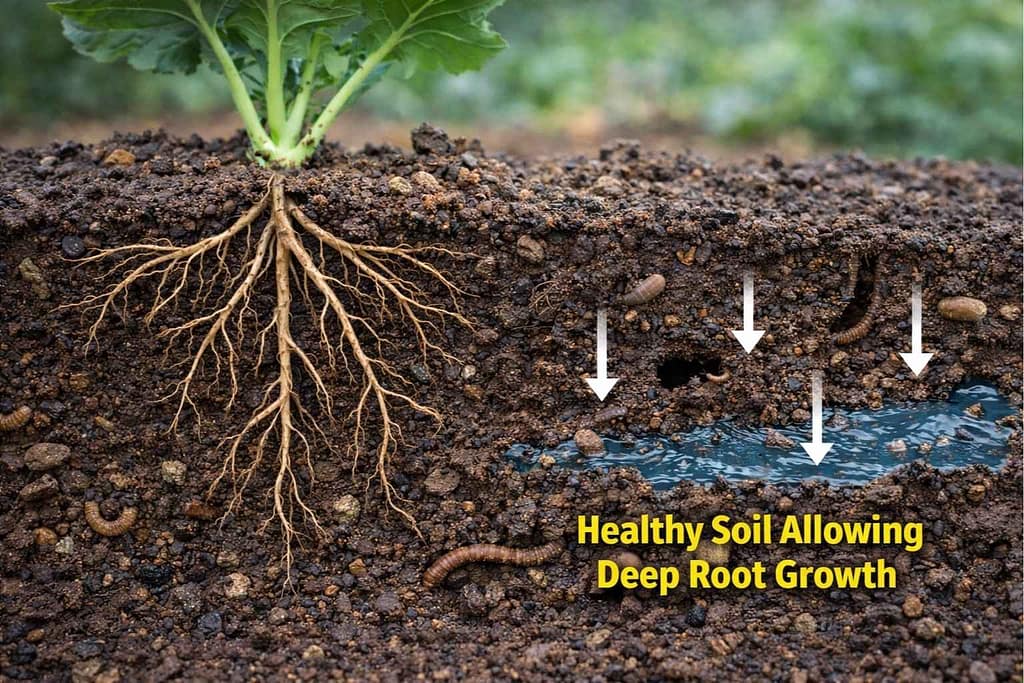
As soil organisms rebuild structure, compacted layers gradually soften.
This creates channels that roots can penetrate naturally.
Build Soil Structure with Organic Matter
Organic matter is the most effective long-term solution for heavy UK soil.
Compost, leaf mould and well-rotted manure improve aggregation.
Worms and microbes create natural tunnels through compacted layers.
Over time this allows:
- Better drainage
- Improved oxygen flow
- Deeper root growth
This process is explained in detail in How to Improve Garden Soil in the UK Long Term.
Use Mulches to Protect and Improve Soil
Organic mulches protect soil from compaction by rain.
They slowly feed soil organisms and encourage structure rebuilding.
Over time mulch is pulled downward into the soil profile.
This steadily improves root conditions without disturbance.
How Long It Takes to Improve Root Depth
Some improvement can be seen within one growing season.
Major structural changes usually take one to three years depending on soil condition.
This timeline is realistic and long lasting.
Patience produces far better results than repeated quick fixes.
Realistic expectations are covered in How Long It Takes to Improve Garden Soil.
Why Fixing Root Depth Transforms Vegetable Growth
Once roots can grow deeply, plants become far more resilient.
Benefits include:
- More consistent growth
- Better drought tolerance
- Improved nutrient uptake
- Stronger stems
- Higher yields
Vegetables no longer stall or suffer constant stress.
Harvests become more reliable year after year.
How This Fits into the Bigger Soil Picture
Shallow roots are rarely an isolated issue.
They are part of the wider soil structure problem affecting many UK gardens.
Poor drainage, compaction and cold soil all interact.
This relationship is explained fully in Why Vegetables Fail in UK Gardens.
Addressing soil as a system delivers the biggest improvements.
Common Questions About Shallow Roots in UK Gardens
Why do plant roots stay shallow in heavy UK soil?
Heavy clay and compacted soil blocks root penetration and holds too much water, limiting oxygen and root growth.
Does compacted soil stop roots growing deep?
Yes. Compaction creates dense layers that roots struggle to push through, forcing them to spread near the surface.
Can poor drainage cause small root systems?
Yes. Waterlogged soil removes oxygen from the root zone, slowing root growth and sometimes causing root damage.
Why do shallow roots make vegetables struggle in hot weather?
Surface soil dries quickly, leaving shallow-rooted plants without stable moisture access.
Does fertiliser fix shallow root problems?
No. Roots in compacted or waterlogged soil cannot absorb nutrients efficiently, even when fertiliser is added.
How can I help roots grow deeper in heavy soil?
Improve drainage, reduce compaction, add organic matter regularly and protect soil with mulch.
How long does it take to improve root depth in UK soil?
Most gardens see noticeable improvement within one season and major improvement within one to three years.
A Sensible Place to Start
If your vegetables struggle to root deeply, focus on improving soil structure rather than feeding more heavily.
Add organic matter regularly, avoid compacting soil when wet, protect beds with mulch and improve drainage where needed.
Over time, roots will naturally grow deeper, plants will become stronger and harvests will improve steadily.
Healthy soil creates healthy root systems — and healthy roots do most of the work for you.