

Many gardeners experience what looks like healthy, vigorous plant growth — but with very little harvest.
Vegetable plants produce masses of lush green leaves, long stems and strong foliage, yet flowers are few, fruits remain small, or crops fail to develop altogether.
At first glance, the garden appears to be thriving.
In reality, this type of growth often signals an imbalance below the soil surface.
While feeding mistakes can sometimes contribute, the most common cause in many gardens is stressed or restricted root systems caused by heavy soil, poor drainage, compaction and unstable moisture levels.
This is one of the growth patterns explained in Why Vegetables Fail in UK Gardens, where soil structure is shown to control how plants balance leaf growth and crop production.
When roots struggle, plants often respond by producing foliage instead of supporting flowers and fruit.
Why Vegetables Grow Lots of Leaves But No Fruit – Quick Answer
- Compacted soil restricts root development
- Waterlogged ground removes oxygen from roots
- Shallow roots create unstable moisture supply
- Cold soil slows nutrient movement
- Root stress shifts energy into leaf growth instead of crops
In many gardens, excessive leafy growth with poor cropping is caused by stressed roots rather than too much fertiliser. Improving soil structure, drainage and root depth usually restores balanced growth and reliable harvests.
Why Leaf Growth Can Look Healthy While Crops Fail
Leaves are relatively easy for plants to produce.
They require fewer long-term resources than flowers and fruits.
When conditions are less than ideal, plants often prioritise leaf growth to capture sunlight and survive.
Fruit and seed production only occurs when the plant has surplus energy and stable access to water and nutrients.
If roots cannot supply resources consistently, the plant limits reproduction.
This is why lush foliage can exist alongside poor harvests.
How Root Stress Pushes Plants Toward Leaf Growth
Roots act as the plant’s supply system.
They control:
- Water absorption
- Nutrient uptake
- Oxygen exchange
- Energy flow to developing crops
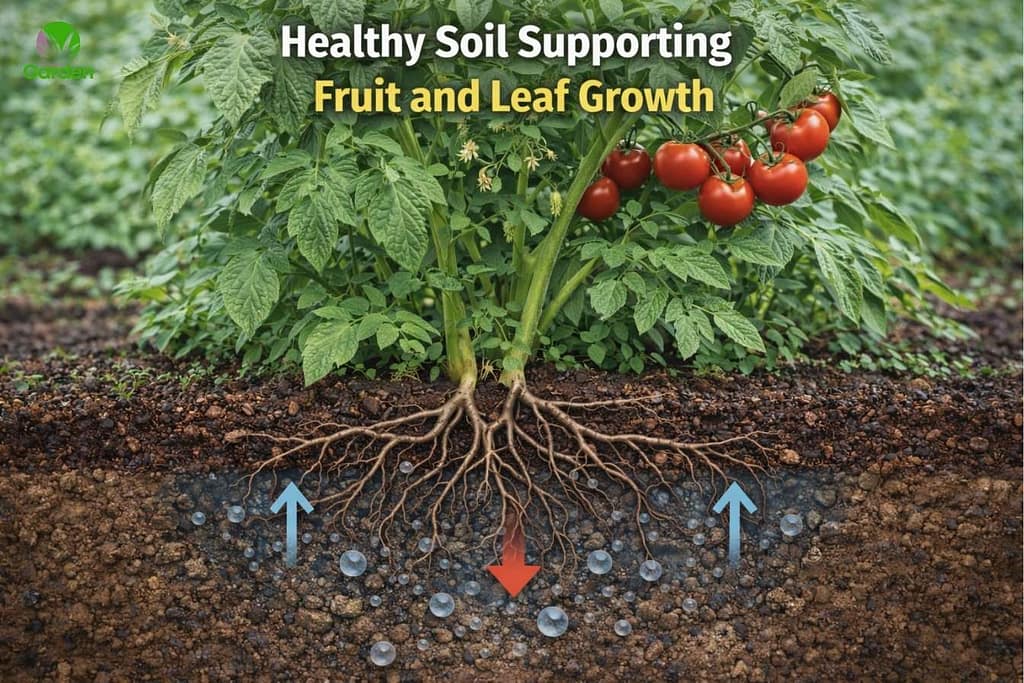
When roots function well, plants support both foliage and fruit.
When roots are restricted or damaged, plants divert energy into survival growth — mainly leaves.
This produces strong vegetative growth with limited reproductive output.
Why Heavy Soil Makes This Problem So Common
Across many gardens, soil is naturally heavy or becomes compacted over time.
Clay-rich soil drains slowly and holds water tightly.
Repeated rainfall, digging and foot traffic compress soil further.
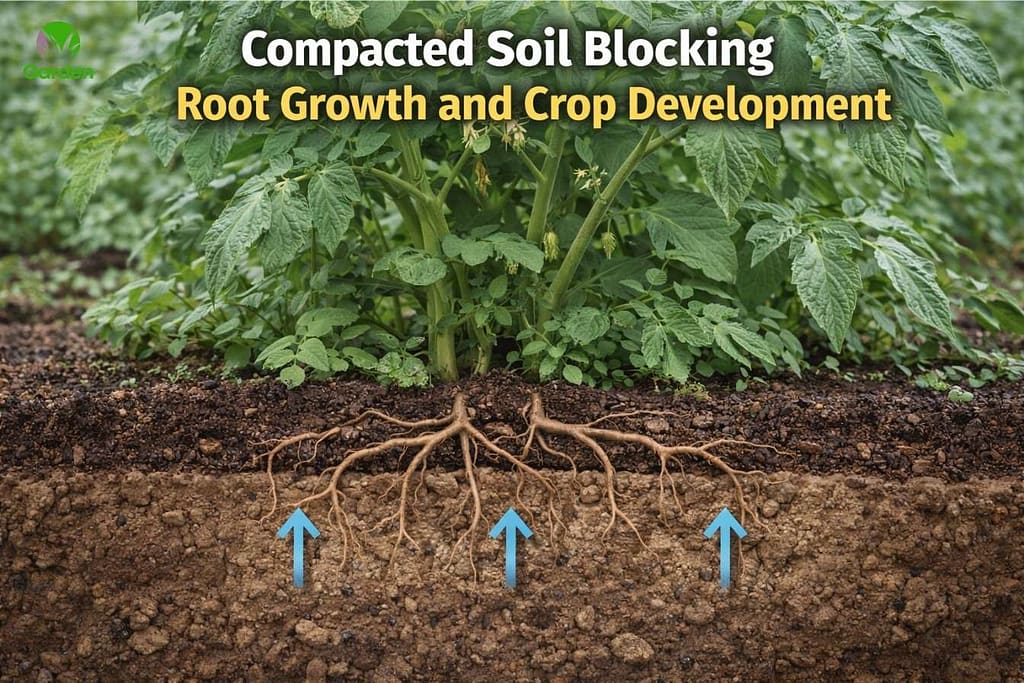
This creates dense layers that restrict root growth and oxygen flow.
Roots remain shallow and stressed.
This issue is closely linked to soil compaction in UK gardens, which quietly limits root development in many vegetable beds.
Poor Drainage and Excess Leaf Growth
When soil remains wet for long periods, oxygen is pushed out of the root zone.
Roots rely on oxygen to absorb nutrients and grow properly.
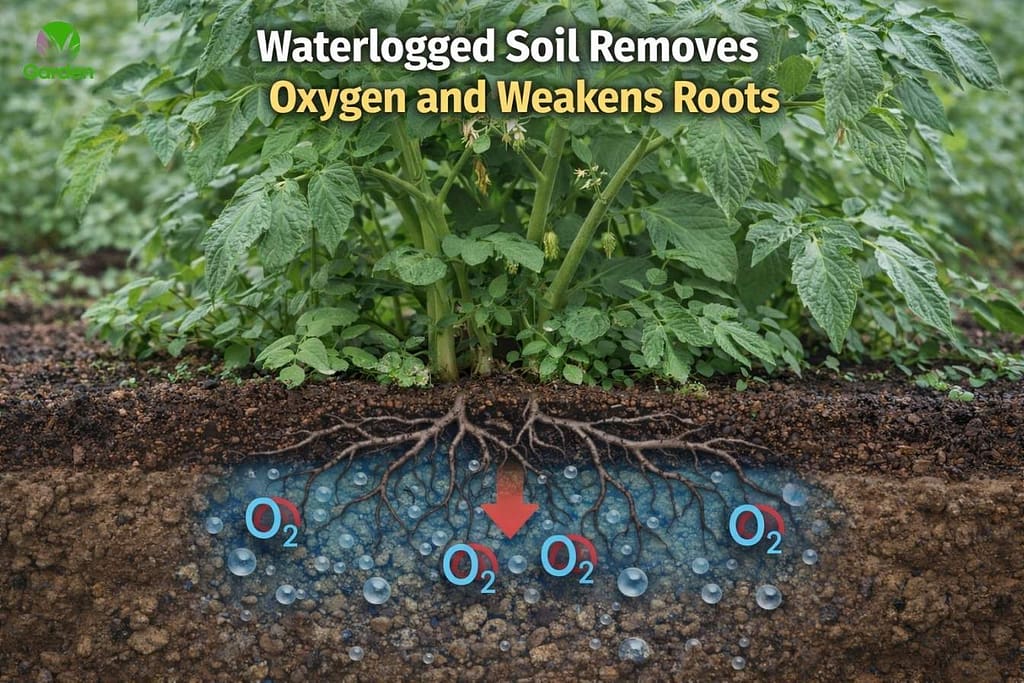
Without it, root systems weaken.
Plants respond by producing leaf growth while failing to support flowers and fruit.
This creates the classic pattern of big leafy plants with little harvest.
Long-term drainage improvement usually brings growth back into balance.
Practical methods are explained in How to Improve Garden Drainage in UK Soil.
How Shallow Roots Create Growth Imbalances
In compacted or heavy soil, roots often spread sideways near the surface.
This shallow root system depends on surface moisture.
Surface soil dries quickly in warm or windy weather.
Each drying cycle stresses the plant.
Instead of supporting fruit development, plants repeatedly shift energy back into leaf growth to recover.
This process is explained in detail in Why Roots Stay Small in Heavy UK Soil.
Cold Soil and Weak Crop Development
Soil temperature strongly affects root activity.
Cold soil slows nutrient uptake and root growth.
In heavy or poorly drained ground, soil warms far later than expected in spring.
This delays flowering strength and crop development.
The temperature effect is covered in Cold Soil Problems in UK Gardens.
Improving structure allows soil to warm faster and stabilise earlier in the season.
When Feeding Makes the Problem Worse
High-nitrogen feeds can encourage leaf growth.
However, in many gardens feeding simply amplifies an existing soil problem.
If roots are stressed, extra nutrients push foliage growth without fixing crop production.
This leads to even larger plants with even fewer harvests.
Why feeding often fails is explained in Why Feeding Plants Often Doesn’t Fix Slow Growth in UK Soil.
Healthy soil always needs to come first.
The next section explains how to correct root conditions properly and restore balanced growth.
How to Fix Vegetables That Grow Leaves But Don’t Produce Fruit
Once it becomes clear that excessive leafy growth with poor cropping is usually driven by root stress rather than simple feeding issues, the solution becomes far more effective.
The aim is not to reduce leaf growth directly, but to improve the soil conditions that allow roots to function normally and support fruit development.
This involves improving drainage, rebuilding soil structure, reducing compaction and encouraging deeper root growth.
Improve Drainage to Restore Root Oxygen
Roots cannot absorb nutrients or grow properly without oxygen.
When soil remains saturated, oxygen is forced out of pore spaces.
Even short periods of waterlogging weaken root systems.
Improving drainage allows excess water to move away and air to return to the soil.
As oxygen levels rise, root growth strengthens and plants regain balance between foliage and fruit production.
Many gardeners notice improved cropping within one growing season once drainage improves.
Long-term methods are covered in How to Improve Garden Drainage in UK Soil.
Reduce Compaction Gradually
Compacted soil forms a physical barrier to healthy root development.
Rather than repeated deep digging, the goal is to allow soil structure to rebuild naturally.
Key steps include:
- Avoid walking on beds when wet
- Limit heavy cultivation
- Protect soil from heavy rain impact
As soil organisms create channels, roots penetrate deeper and more freely.
This stabilises moisture supply and reduces repeated stress events.
Build Soil Structure with Organic Matter
Organic matter is the most powerful long-term fix for heavy or compacted soil.
Compost, leaf mould and well-rotted manure improve aggregation and porosity.
Worms and microbes form natural tunnels that improve drainage and oxygen movement.
This process is explained fully in How to Improve Garden Soil in the UK Long Term.
As soil improves, roots grow deeper and stronger naturally.
Encourage Balanced Growth Naturally
Once root systems stabilise, plants no longer need to divert energy into constant leaf recovery.
Moisture and nutrient uptake becomes consistent.
Flowering becomes stronger and fruit set more reliable.
Balanced growth returns without forcing or overfeeding.
Seasonal Patterns in Leafy Growth and Cropping
Understanding seasonal soil behaviour explains why some years are worse than others.
Spring
Cold, wet soil limits root activity.
Leaf growth may begin while crop development remains weak.
Improved structure allows soil to warm faster and support early flowering properly.
Summer
Shallow-rooted plants struggle during dry spells.
Repeated stress pushes energy back into foliage growth.
Deep-rooted plants remain stable and productive.
Autumn
Heavy rainfall highlights drainage and compaction problems.
Waterlogged roots struggle to support late crops.
This is the ideal time to rebuild soil with organic matter.
How Long It Takes to Restore Balanced Growth
Some improvement may be visible within one growing season.
Major structural changes typically take one to three years.
This depends on soil condition and consistency of improvement.
This realistic timeline is explained in How Long It Takes to Improve Garden Soil.
Why Healthy Soil Creates Reliable Harvests
Once soil structure improves and roots function normally, most growth imbalance disappears naturally.
Benefits include:
- Consistent flowering and fruit set
- Reduced stress during dry periods
- Improved nutrient efficiency
- Stronger plants
- Higher yields
Instead of reacting to symptoms each season, gardeners create conditions where vegetables thrive.
Common Questions About Vegetables Growing Leaves But Not Producing Fruit
Why do my vegetables grow lots of leaves but no fruit?
This usually happens when roots are stressed by compacted soil, poor drainage or shallow root systems, which pushes plants to prioritise leaf growth over crop production.
Is too much fertiliser the main cause of leafy growth without crops?
Excess nitrogen can contribute, but in most gardens soil structure and root health are the main causes.
Can poor drainage stop vegetables from producing fruit?
Yes. Waterlogged soil removes oxygen from roots and weakens nutrient uptake, interrupting fruit development.
Why do plants look healthy but fail to crop?
Leaf growth is easier for plants to maintain than fruit development when root conditions are unstable.
Does compacted soil affect fruit production?
Yes. Compaction restricts root growth, causes shallow rooting and increases stress during dry or wet conditions.
How can I restore balanced growth in vegetables?
Improve drainage, reduce compaction, add organic matter regularly and protect soil structure.
How long does it take to fix this problem?
Some improvement can occur within one season, but rebuilding soil structure usually takes one to three years.
A Sensible Place to Start
If your vegetables grow lots of leaves but produce little fruit, focus on improving soil structure rather than reducing feeding alone.
Address drainage problems, reduce compaction and build soil gradually with organic matter.
As roots become healthier and deeper, plants naturally rebalance growth and begin producing reliable crops.
Healthy soil does most of the work for you.